Friday, May 20, 2011

# 1 Box Jellyfish


The top prize for “The World Most Venomous Animal,” would go to the Box Jellyfish. It has caused at least 5,567 recorded deaths since 1954. Their venom is among the most deadly in the world. It’s toxins attack the heart, nervous system, and skin cells. And the worst part of it is that jelly box venom is so overpoweringly painful, that human victims go in shock, drown or die of heart failure before even reaching shore. Survivors experience pain weeks after the contact with box jellies. You have virtually no chance to survive the venomous sting, unless treated immediately. After a sting, vinegar should be applied for a minimum of 30 seconds. Vinegar has acetic acid, which disables the box jelly’s nematocysts that have not yet discharged into the bloodstream (though it will not alleviate the pain). Wearing panty hose while swimming is also a good prevention measure since it can prevent jellies from being able to harm your legs.Jelly box can be found in the waters around Asia and Australia.
10 Most Poisonous Animals in the World

# 2 King Cobra


The King Cobra (Ophiophagus hannah) is the world’s longest venomous snake – growing up to 5.6 m (18.5 ft) in length. Ophiophagus, literally means “snake-eater” as it eats other snakes. One single bite of this deadly snake can easily kill a human. This snake is even capable of killing a full-grown Asian Elephant within 3 hours if the larger animal is bitten in a vulnerable area such as the trunk. It’s venom is not as toxic as other venomous snakes, but King Cobra is capable of injecting 5 times more venom than black mamba and can result in mortality up to 5 times faster than that of the black mamba. It is quite widespread, ranging across South and South-east Asia, living in dense highland forests.
10 Most Poisonous Animals in the World

# 3 Marbled Cone Snail


This little beautiful looking Marbled Cone snail can be as deadly as any other animal on this list. One drop of its venom is so powerful that it can kill more than 20 humans. If you ever happen to be in warm salt water environment (where these snails are often found) and see it, don’t even think of picking it up. Of course, the true purpose of its venom is to catch its prey. Symptoms of a cone snail sting can start immediately or can be delayed in onset for days. It results in intense pain, swelling, numbness and tingling. Severe cases involve muscle paralysis, vision changes and breathing failure. There is no antivenom. However, only about 30 human deaths have been recorded from cone snail envenomation.
10 Most Poisonous Animals in the World

# 4 Blue-Ringed Octopus


The Blue-Ringed Octopus is very small, only the size of a golf ball, but its venom is so powerful that can kill a human. Actually it carries enough poison to kill 26 adult humans within minutes, and there is no antidote. They are currently recognized as one of the world’s most venomous animals. Its painless bite may seem harmless, but the deadly neurotoxins begin working immediately resulting in muscular weakness, numbness, followed by a cessation and breathing and ultimately death. They can be found in tide pools in the Pacific Ocean, from Japan to Australia.
10 Most Poisonous Animals in the World

5 Death Stalker Scorpion


Contrarily to the popular belief most of the scorpions are relatively harmless to humans as stings produce only local effects (pain, numbness or swelling). However, the Death Starker Scorpion is highly dangerous species because its venom is a powerful cocktail of neurotoxins which causes an intense and unbearable pain, then fever, followed by coma, convulsions, paralysis and death. Fortunately, while a sting from this scorpion is extremely painful, it would be unlikely to kill a healthy, adult human. Young children, the old, or infirm (with a heart condition) are at the biggest risk. Death stalker scorpions are spread in North Africa and Middle East.
10 Most Poisonous Animals in the World

# 6 Stonefish


Maybe Stonefish would never win a beauty contest, but it would definitely win the top prize for being “The World Most Venomous Fish”. Its venom causes such a severe pain that the victims of its sting want the affected limb to be amputated. It is described as the worst pain known to man. It is accompanied with possible shock, paralysis, and tissue death. If not given medical attention within a couple of hours It can be fatal to humans. Stonefish stores its toxins in gruesome-looking spines that are designed to hurt would-be predators. Stonefish mostly live above the tropic of Capricorn, often found in the shallow tropical marine waters of the Pacific and Indian oceans, ranging from the Red Sea to the Queensland Great Barrier Reef.
10 Most Poisonous Animals in the World

# 7 The Brazilian wandering spider


The Brazilian Wandering Spider (Phoneutria) or banana spider appears in the Guinness Book of World Records 2007 for the most venomous spider and is the spider responsible for most human deaths. This spider is believed to have the most potent neurotoxic venom of any living spider. Only 0.006mg (0.00000021oz) is sufficient to kill a mouse. They are also so dangerous because of their wandering nature. They often hide during daytime in highly populated areas inside houses, clothes, boots, and cars. Its venomous bite causes not only intense pain, the venom of the spider can also cause priapism – uncomfortable erections lasting for many hours that lead to impotence.
10 Most Poisonous Animals in the World

# 8 Inland Taipan


The prize for “The World’s Most Venomous Snake” goes to the Inland Taipan of Australia. Just a single bite from this snake contains enough venom to kill 100 human adults or an army of 250,000 mice. Its venom is at least 200 – 400 times more toxic than a common cobra. The Inland Taiwan’s extremely neurotoxic venom can kill an adult human in as little as 45 minutes. Fortunately this snake is very shy and there have been no documented human fatalities (all known bites were treated with antivenin).
10 Most Poisonous Animals in the World

# 9 Poison Dart Frog


If you ever happen to be running through the rain forests somewhere in Central or South America, do not ever pick up beautiful and colorful frogs – it can be the Poison Dart Frog. This frog is probably the most poisonous animal on earth.The 2 inch long (5cm) golden poison dart frog has enough venom to kill 10 adult humans or 20,000 mice. Only 2 micrograms of this lethal toxin (the amount that fits on the head of a pin) is capable of killing a human or other large mammal. They are called “dart frogs” because indigenous Amerindians’ use of their toxic secretions to poison the tips of their blow-darts. Poison dart frogs keep their poison in their skins and will sicken or kill anybody who touches or eats it.
10 Most Poisonous Animals in the World

10 Most Poisonous Animals in the World


It is really hard to tell which animal is the most poisonous in the world. The one that has the most toxic chemicals? The one that kills the biggest amount of people a year? Or maybe the one with the biggest amount of poison? First of all, I have to admit that the title is a bit incorrect, because there is a difference between poisonous and venomous animals. A poisonous animal carries harmful chemicals called toxins primarily used for self defense. Therefore venomous animals deliver their toxins by stinging, stabbing, or biting. So poisonous animals are passive killers, while venomous animals are active killers. Nevertheless, theory aside, they are all really dangerous. So look really closely at each photo, cause next time you meet them can be the last thing you ever see.

# 10 Puffer Fish

Puffer Fish are the second most poisonous vertebrate on earth (the first one is golden dart Frog). The meat of some species is a delicacy in both Japan (as fugu) and Korea (as bok-uh) but the problem is that the skin and certain organs of many puffer fish are very poisonous to humans. This puffy fish produce rapid and violent death..Puffer’s poisoning causes deadening of the tongue and lips, dizziness, vomiting, rapid heart rate, difficulty breathing, and muscle paralysis. Victims die from suffocation as diaphragm muscles are paralyzed. Most of the victims die after four to 24 hours. There is no known antidote, Most deaths from fugu happen when untrained people catch and prepare the fish. Statistics show that there were 20 to 44 incidents of fugu poisoning per year between 1996 and 2006 in all of Japan and up to six incidents per year led to death. Since Fugu’s poison can cause near instantaneous death, only licensed chefs are allowed to prepare it.
10 Most Poisonous Animals in the World


Tuesday, April 12, 2011

Caterpillars


Caterpillars come in a variety of colors, shapes and sizes. Their beauty can often be deceiving since their hairs often contain venom which can be poisonous to humans and predators. Toxic caterpillars can be found in many places including backyard gardens, parks and fields. The following list describes 10 of the most beautiful, yet dangerously toxic caterpillars in the world.

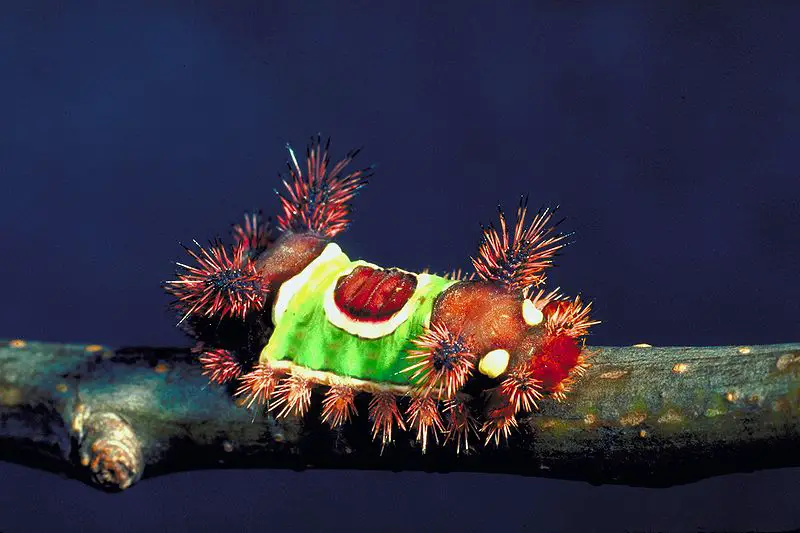
Acharia stimulea e1300854638172 10 Beautiful Yet Toxic Caterpillars
This unique looking slug caterpillar is mostly green with brown at each end with a white-ringed purple-brown dot in the center which looks like a saddle. When fully grown, it measures approximately one inch long and 3/8 inch wide. It has a pair of fleshy horns at each end which contain hairs that secrete irritating venom along with protruding spines in every direction. Its stings are painful and can cause swelling, nausea and a rash which lasts for days. The Saddleback Caterpillar can be found in gardens, flower pots, fields and forests. It eats everything from garden plants to trees and shrubs.

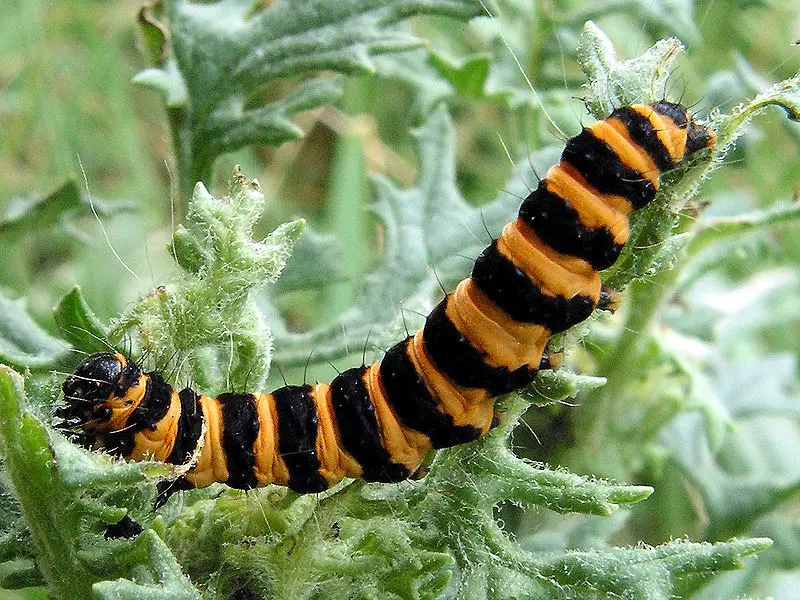
Tyria jacobaeae caterpillar e1300854752309 10 Beautiful Yet Toxic Caterpillars
This creature starts off pale yellow, but later develops the bright orange/yellow and jet black striped bands. It has a voracious appetite and can consume entire areas of weeds. When it runs out of food, or sometimes for no apparent reason, it can actually turn cannibalistic. The Cinnabar Moth Caterpillar was introduced into New Zealand, Australia and North America to biologically control poisonous ragwort and Tansy. Oftentimes, these caterpillars cluster together in an attempt to defend themselves against predators. As they age, they tend to act aggressively toward each other. Survival is often cut short due to completely consuming food sources before reaching maturity.

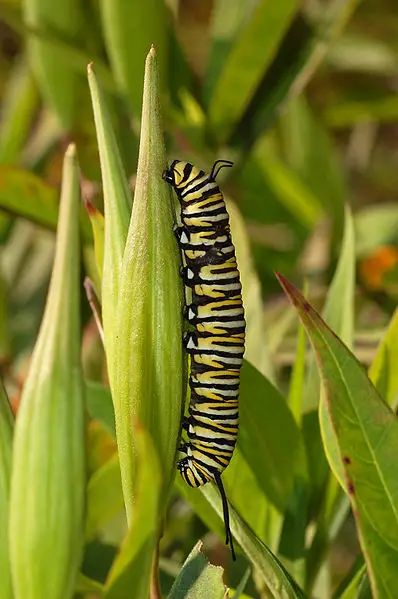
Monarch Butterfly Danaus plexippus Vertical Caterpillar 10 Beautiful Yet Toxic Caterpillars
This yellow, black and white striped caterpillar is so small immediately after hatching that it can barely be seen. It has two pairs of black filaments, one pair on each end of the body. It grows very fast, feeds only on milkweed leaves and cannot exist without them. When fully grown, the Monarch Caterpillar is about 2 inches long. Although beautiful to look at, it is poisonous or distasteful to birds and mammals due to cardiac glycosides that are contained in the milkweed it eats. When the Monarch Caterpillar emerges into a butterfly, it is considered the most beautiful and “king” of all butterflies.

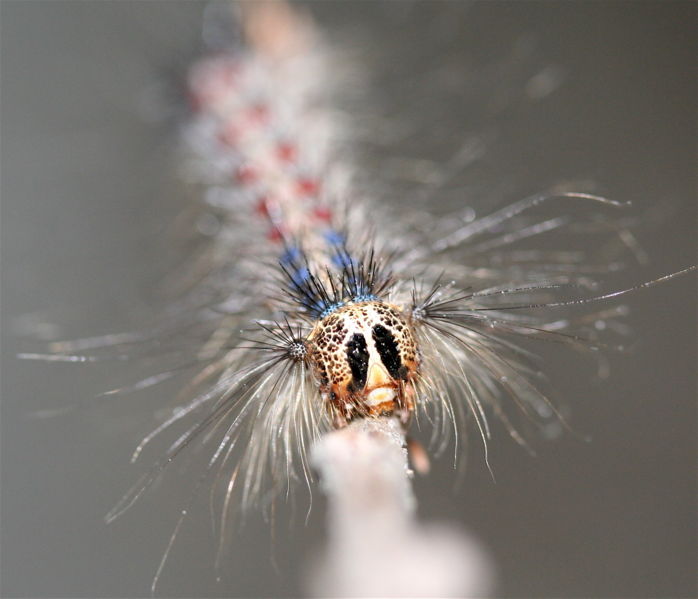
gypsy moth catepillar e1300854931987 10 Beautiful Yet Toxic Caterpillars
Present from May through mid-July, newly hatched Gypsy Moth Caterpillars are black with long stiff bristles. Older caterpillars have five pairs of raised blue spots and six pairs of raised red spots on their backs with fewer hairs. The hairs can cause pain on contact and lead to dermatitis. In order to spread throughout the forest, they climb to tree tops, spin a thread, dangle from it and wait for the breeze to carry them away. These caterpillars love to feed on certain types of leaves, such as maple, elm and oak. Damage from feeding infestations can cause complete defoliation leading to disease, vulnerability to other insects or tree death.

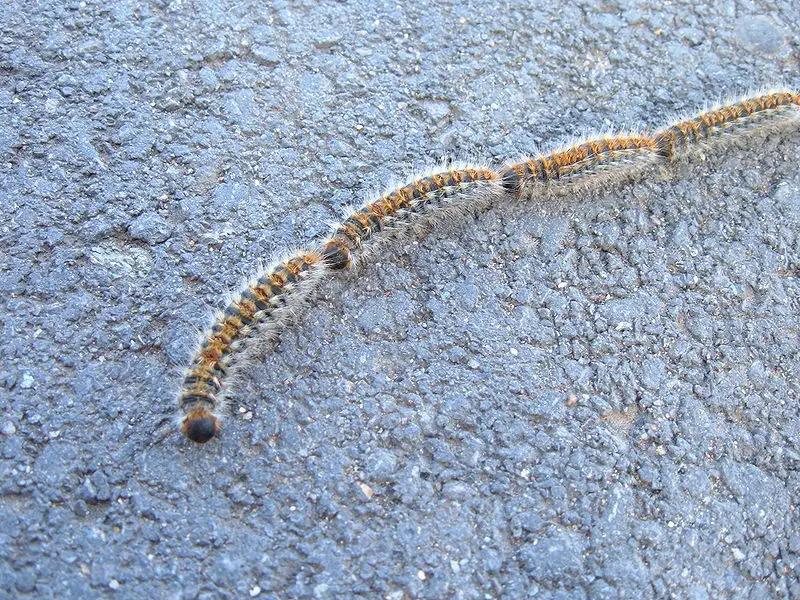
Thaumetopoea pityocampa e1300854998338 10 Beautiful Yet Toxic Caterpillars
Known as Processionary Caterpillars for walking in processions, these are amongst the most dangerous and should not be touched. Coming in contact with one can cause external and internal bleeding. The poison contains chemicals which are potent enough to cause humans to bleed to death. Airborne hairs will cause rashes and respiratory problems. Bag Shelter Caterpillars are dark brown with a brown head and long soft hairs. They live inside a brown bag made of silk and come out at night to feed. They can be found resting or hiding on the base of medium to large size wattle tree trunks and eat the leaves.

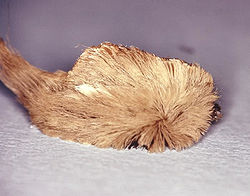
Puss caterpillar1 10 Beautiful Yet Toxic Caterpillars
The most poisonous caterpillar in North America is the Puss or Woolly Slug Caterpillar. Don’t be fooled by its fluffy cotton ball appearance as it will release acid on anything that touches it and is loaded with poisonous spines all over its body. Although the long, soft hairs are harmless, the spines can cause immediate, excruciating pain. Symptoms from a sting can last several days and include headache, nausea and vomiting. Its colors vary from grayish-white to golden-brown to dark charcoal gray and its body tapers to a tail. These inch long caterpillars can be found in citrus trees, elms, oaks and garden plants.

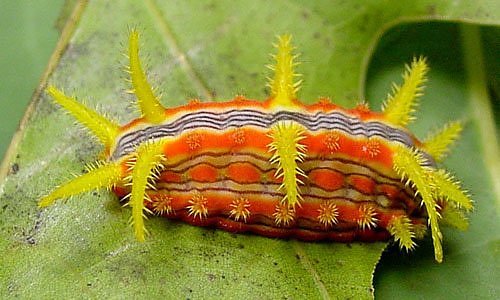
rose slug 10 Beautiful Yet Toxic Caterpillars
The flamboyant Stinging Rose or Rose Slug Caterpillar is less than an inch long and comes in red, orange and yellow with purple and green pinstripes. It proudly wears its bright colors as a warning announcing how dangerous it is; aka aposematic coloration. This colorful species has black-tipped spines with poison glands. Touching this caterpillar will cause the tips of the spines to break off and venom to enter the skin. This can cause an irritating skin rash and a hypersensitive reaction. These caterpillars can be found on woody plants such as dogwood, maple, oak, cherry, apple, poplar and hickory.

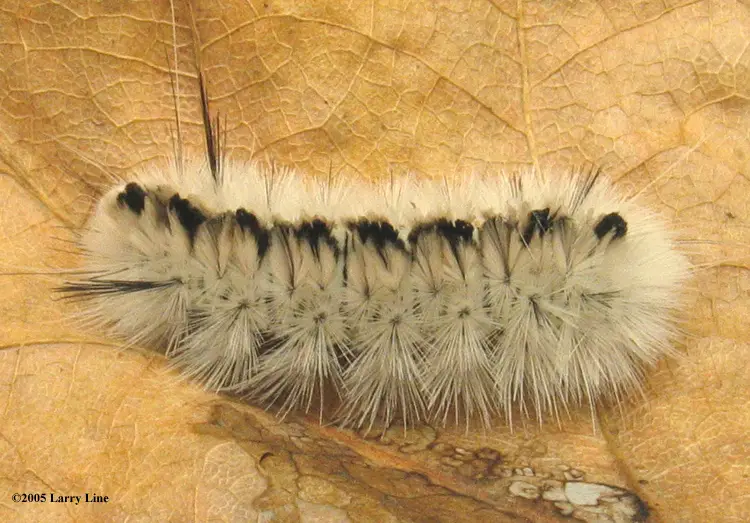
Lophocampa caryae M 2 e1300855309421 10 Beautiful Yet Toxic Caterpillars
These black and white caterpillars are covered in grayish-white hairs with black spots on the sides and black tufts along the middle of the back. Two long, sharp, thin black hairs protrude from the front and back of the caterpillar connected to poison glands. Poisoning occurs when coming into contact with hairs or spines and causes skin rashes or hypersensitivity. Hickory Tussock Caterpillars are commonly seen from June to September and can be found in southern Canada and parts of North America. They feed for about eight weeks on hickory, pecan and walnuts in addition to elm, oak and willow.

Io moth caterpillar1 10 Beautiful Yet Toxic Caterpillars
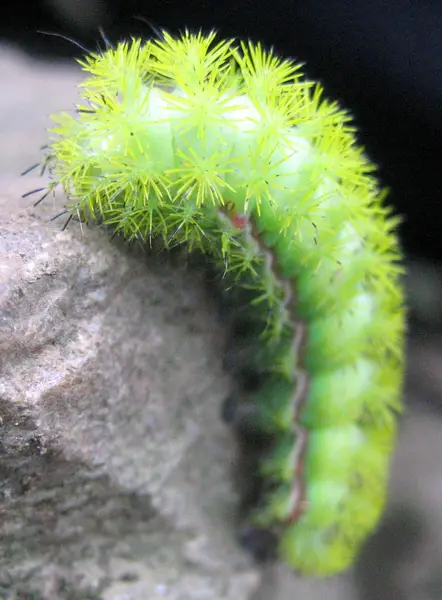
As the Io Moth Caterpillar develops, it goes from orange to bright green with red and white stripes running the length of the body. These two inch creatures tend to travel in single file processions over food plants and young caterpillars feed in groups. Two types of poisons are released from their spines with the slightest touch and pack a powerful sting, burning sensation and inflammation. They feed on many trees and shrubs including willow, maple, elm, oak, holly, aspen, locust, cherry, pear and sassafras. This species can be found in open woods, meadows and cornfields from February through September.

SpinyOakSlugLarva 10 Beautiful Yet Toxic Caterpillars
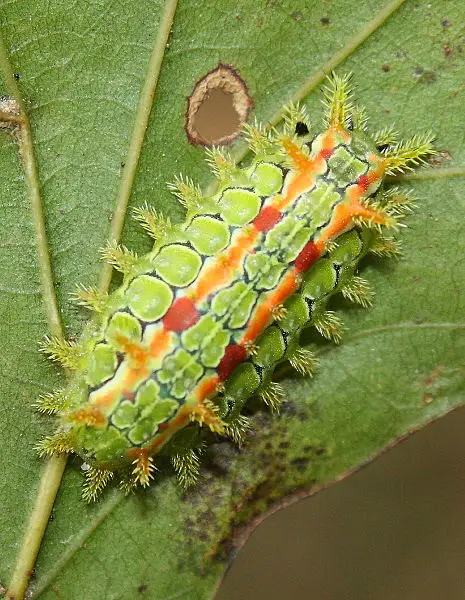
This beautiful caterpillar comes in a rainbow of pastel colors including green, blue, pink and yellow and is a little less than an inch long. It is rather flat and has four clusters of darker spines near the hind end. Poison released by the spines can cause a severe reaction and warrant medical attention. The Spiny Oak Slug Caterpillar likes to feed on sycamore, willow, ash, oak, hackberry and chestnut along with other trees and smaller woody plants. This species can be found in the woodlands from southern Quebec to Maine and south through Missouri, Texas and Florida.

rabbit


the Amami rabbit is a Japanese national treasure but even so this elusive rabbit is mostly unknown even to the population of Japan. Reason for the Amami rabbit not being very well known could be down to the fact that it can only be found on two islands in southern Japan, Amami and Tokuno islands. There is thought to be only around 3000 – 5000 Amami rabbit’s left on these islands with the island of Tokuno having the smaller population of around 500 or so.
Currently listed as endangered the Amami rabbit population is in decline for two reasons; habitat loss due to human expansion and loss of numbers due to predators that have been introduced to the islands from outside sources.
amamirabbit1 Amami rabbit
Out in the daylight, truly a rare sight
This stocky rabbit is considered as a living fossil among scientists due to the fact that it more resembles the rabbit’s common ancestors than other species of rabbit that are around today. Features such as small stocky limbs with over-sized claws and physical characteristics differing from other rabbits in such ways as smaller eyes/ears and a longer pronounced snout set the Amami rabbit aside from its relatives and make it easily distinguishable.
The Amami rabbit’s keep away from populated areas and farmland and prefer a woodland habitat that has matured and is a fair distance from humans and other predators. Although it was commonly thought that these dark furred rabbits preferred old, mature forests recent research has found that the preferred habitat actually seems to be that of younger forests that border of much more ancient forests.
amamirabbit2 Amami rabbit
Roaming the night
Predominently a solitary creature the Amami rabbit’s tend to spend most of their time with only themselves for company and spend their days sleeping in underground lairs or any sheltered crevices. The Amami rabbit’s are nocturnal so are active throughout the night where they will spend most of their time looking for food. The preferred diet of the Amami rabbit is that of grass, fruit and in the winter, acorns.
The female Amami rabbit’s take great care of their young and this occupies most of their time due to the fact that they usually birth twice a year, each time producing 2 or 3 offspring. The mother Amami rabbit will keep her young in her lair and seal the lair whenever she isn’t around ensuring her young are safe from predators.